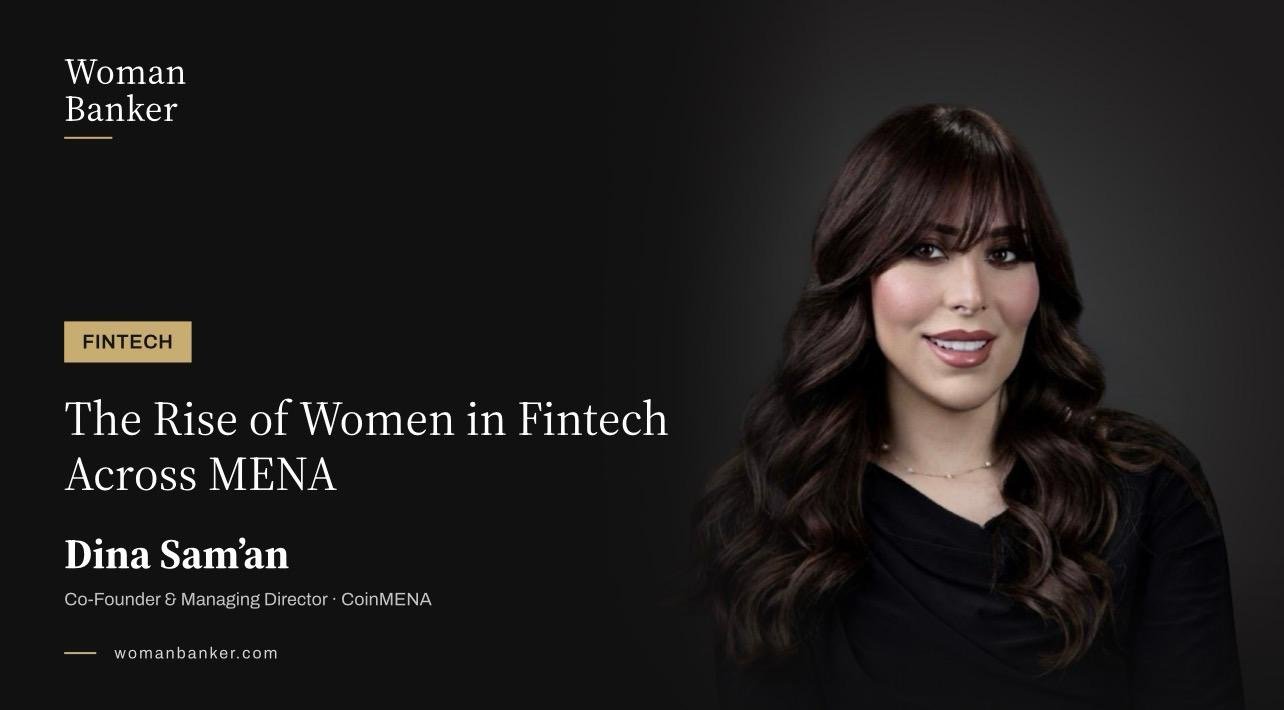
Financial technology has changed how people across MENA save, invest, and think about money. Behind that change are leaders willing to enter unfamiliar territory and build new platforms while the industry takes form. Dina Sam’an is one of them.
A Jordanian entrepreneur and digital finance leader, she is the Co-Founder and Managing Director of CoinMENA. She co-founded the platform in 2020 alongside Talal Tabbaa. Her path runs from her family’s real estate business to a regulated regional fintech company. It mirrors a wider shift: women in MENA fintech are moving from taking part in the sector to leading it.
Her story carries a useful lesson. Leadership in this field means reading where finance is heading, understanding regulation, and having the courage to build.
Expertise Built Step by Step
Her career began in her family’s real estate business, where she learned firsthand what it takes to grow a venture. She then moved into digital assets, heading straight for the point where technology and finance met. In 2020, she co-founded CoinMENA to build a regulated digital asset platform with stable banking relationships for customers across the region. CoinMENA had raised close to $20 million from top investors including BECO, Arab Bank Switzerland, Circle, and Bunat Ventures.
Starting a company in that environment takes more than enthusiasm for new technology. Digital finance operates inside a tightly regulated system. Founders must master compliance, partnerships, and institutional trust as much as innovation.
From Innovation to Trust
CoinMENA grew alongside the regional digital finance ecosystem. The company secured licenses from the Central Bank of Bahrain and Dubai’s Virtual Assets Regulatory Authority (VARA). It also built ties with established institutions, including a strategic partnership with Zand in 2025 and selecting Standard Chartered as its UAE banking partner in 2026.
Her achievements earned extensive recognition. Forbes Middle East named her to its 30 Under 30 list in 2022 and recognized her among top women behind Middle Eastern tech brands. She won the global “Woman in Web3” award, “Woman of the Year” by Women Changing the World, and Best Founder at BeInCrypto & Wirex’s Rising Women in Crypto Awards 2024. Under her leadership, CoinMENA achieved 400% YoY growth, surpassed $5 billion in trading volume, and scaled its user base to over 1.5 million investors.
In December 2025, Türkiye’s leading digital asset platform, Paribu, acquired CoinMENA in a transaction valued at up to $240 million. The deal showed what happens when an emerging fintech business turns an idea into a scalable platform.
Bringing the Journey Back to Jordan
The most personal chapter came in September 2026. CoinMENA began operating within the Central Bank of Jordan’s Regulatory Sandbox for FinTech Innovations, known as JoRegBox, becoming the first digital-asset platform to go live there. Jordanian users can now buy, sell and store digital assets locally, under the central bank’s oversight, using bank transfers and the CliQ instant-payment system.
CoinMENA presented the launch as a homecoming for its two Jordanian founders. In a joint statement, Dina Sam’an and Talal Tabbaa called it “a historic moment for both CoinMENA and the region” and pledged to work with the Central Bank of Jordan on a transparent, secure environment for users.
Many entrepreneurs build their careers by looking outward: they move to larger markets, work with international organisations and develop expertise abroad. There is a different kind of achievement in bringing that experience back to the market where the journey began.
Why Her Story Matters
The debate about women in fintech often narrows to representation. Those numbers matter, but they do not tell the whole story. Leadership also changes when women are visible in roles that build businesses, negotiate institutional partnerships, navigate regulation, and set strategy.
Dina’s career is an example of that broader leadership. Beyond corporate success, she remains deeply committed to youth empowerment and bridging the gap between industry and academia. She serves as the youngest-ever Board Member at Princess Sumaya University for Technology in Jordan, an Advisory Board Member for Women in Tech Bahrain, and a global Ambassador for Women Changing the World. She regularly leads university workshops and mentors aspiring founders globally through the startup incubator Ignyte.
The Human Side of Building in Fintech
Funding rounds, licenses, and acquisitions make headlines. Behind them sits work that rarely gets noticed. Building in an emerging industry means living with uncertainty, learning as regulation changes, and making decisions with no established playbook.
Dina entered digital assets when the sector was still young in MENA. She helped build a company that earned both customer confidence and regulatory credibility. Her experience shows that fintech leadership is as much about adaptability as technology.
For aspiring women in the sector, the lesson is clear. A career does not need a perfectly designed path. Experience in one industry can become valuable in another. Operational expertise can lead to entrepreneurship. Regional knowledge can become a competitive advantage.
MENA’s Next Generation of Financial Leaders
The MENA fintech landscape is increasingly diverse. Traditional banking now sits alongside digital payments, embedded finance, and digital assets. Leaders in this ecosystem must bring commercial judgment, regulatory awareness, and deep knowledge of regional customers. Dina’s career sits right at that intersection.
It also shows why regional context matters. MENA is not one uniform market. Jordan, Bahrain, the UAE, and their neighbors each have their own regulatory structures and financial ecosystems. Building across them requires adapting locally without losing sight of a broader vision.
Dina’s journey shows what that evolution looks like: ambitious yet regionally anchored, commercially focused, and built on the belief that new financial technologies create opportunities for both businesses and the people they serve.
By Omkar Kurtkoti